- English
- French
- German
- Portuguese
- Spanish
- Russian
- Japanese
- Korean
- Arabic
- Greek
- German
- Turkish
- Italian
- Danish
- Romanian
- Indonesian
- Czech
- Afrikaans
- Swedish
- Polish
- Basque
- Catalan
- Esperanto
- Hindi
- Lao
- Albanian
- Amharic
- Armenian
- Azerbaijani
- Belarusian
- Bengali
- Bosnian
- Bulgarian
- Cebuano
- Chichewa
- Corsican
- Croatian
- Dutch
- Estonian
- Filipino
- Finnish
- Frisian
- Galician
- Georgian
- Gujarati
- Haitian
- Hausa
- Hawaiian
- Hebrew
- Hmong
- Hungarian
- Icelandic
- Igbo
- Javanese
- Kannada
- Kazakh
- Khmer
- Kurdish
- Kyrgyz
- Latin
- Latvian
- Lithuanian
- Luxembou..
- Macedonian
- Malagasy
- Malay
- Malayalam
- Maltese
- Maori
- Marathi
- Mongolian
- Burmese
- Nepali
- Norwegian
- Pashto
- Persian
- Punjabi
- Serbian
- Sesotho
- Sinhala
- Slovak
- Slovenian
- Somali
- Samoan
- Scots Gaelic
- Shona
- Sindhi
- Sundanese
- Swahili
- Tajik
- Tamil
- Telugu
- Thai
- Ukrainian
- Urdu
- Uzbek
- Vietnamese
- Welsh
- Xhosa
- Yiddish
- Yoruba
- Zulu
A105 Forged Steel Flanges Explained: Key Mechanical Properties and ASTM Specifications
Aug 27 2026
A105 Forged Steel Flanges represent the standard for carbon steel piping components designed for ambient and higher-temperature service in pressure systems. As the most widely used material specification for forged piping products, ASTM A105 ensures that flanges possess the necessary structural integrity to withstand rigorous industrial applications. This comprehensive guide explores the metallurgical makeup, mechanical properties, and manufacturing standards that define these critical components, providing engineers and procurement specialists with the technical knowledge required to ensure system safety and longevity.

Understanding the ASTM A105 Specification
The ASTM A105/A105M specification covers seamless forged carbon steel piping components, primarily flanges, fittings, valves, and similar parts. Unlike cast steel, which is poured into molds, forged steel is shaped using localized compressive forces, typically delivered by a hammer or a die. This forging process refines the grain structure of the steel, eliminating voids and porosity that are often found in castings.
The "A105" designation specifically refers to a normalized carbon steel. Normalization is a heat treatment process where the steel is heated to a specific temperature and then cooled in air. This process refines the grain size, improves the uniformity of the microstructure, and enhances the mechanical properties, specifically ductility and toughness. For piping systems operating in non-corrosive environments at temperatures up to roughly 425°C (800°F), this material offers an optimal balance of strength, cost-effectiveness, and weldability.
Chemical Composition and Metallurgy
The performance of A105 Forged Steel Flanges is dictated by their chemical composition. The strict control of elements such as Carbon, Manganese, Silicon, Sulfur, and Phosphorus is vital for ensuring the material meets its mechanical requirements.
· Carbon (C): The maximum carbon content is generally capped at 0.35%. Carbon is the primary hardening element in steel, providing strength. However, excessive carbon can reduce weldability and increase the risk of cracking during the forging process.
· Manganese (Mn): Ranging typically between 0.60% and 1.05%, manganese increases the strength and hardness of the steel. It also aids in deoxidizing the steel during the melting process.
· Silicon (Si): Silicon is primarily used as a deoxidizer. In A105, it is usually present in amounts up to 0.35%.
· Sulfur (S) and Phosphorus (P): These are considered impurities and are kept to low levels (typically max 0.050%) to prevent hot shortness (cracking at high temperatures) and to maintain toughness.
The precise balance of these elements ensures that the flange can undergo the necessary thermal and mechanical processing without developing internal stresses or micro-fractures.
Key Mechanical Properties
When specifying flanges for high-pressure or critical service, the mechanical properties are just as important as the chemical composition. The ASTM A105 standard mandates specific minimum and maximum values to ensure reliability.
· Tensile Strength: The material must exhibit a tensile strength between 485 and 655 MPa (70 to 95 ksi). This metric indicates the maximum stress the material can withstand while being stretched or pulled before breaking.
· Yield Strength: The minimum yield strength is set at 250 MPa (36 ksi). This is the stress point at which the material begins to deform plastically. Beyond this point, the deformation is permanent.
· Elongation: A105 steel must demonstrate an elongation of at least 30% in a 2-inch gauge length. This high ductility is crucial for absorbing shock loads and vibrations within a piping system without fracturing.
· Hardness: The maximum Brinell hardness is typically limited to 187 HB. Controlling hardness is essential for machinability and to ensure the flange is not too brittle for welding operations.
These properties make the A105 Forged Steel Flanges suitable for a wide range of pressure classes, from Class 150 up to Class 2500, depending on the operating temperature.
The Forging Process and Microstructure
The superiority of forged flanges over cast alternatives lies in the manufacturing process. During forging, the steel billet is heated and subjected to immense pressure. This compressive force causes the metal's grain flow lines to follow the contours of the flange shape.
In a cast flange, the grain structure is random and isotropic. In a forged flange, the grain flow is continuous and directional. This alignment significantly improves the fatigue resistance and impact strength of the component. For applications involving cyclic loading—such as pumps and compressors where vibration is constant—this structural integrity is non-negotiable. Furthermore, the forging process consolidates the metal, closing up any internal cavities or gas pockets that could act as initiation points for corrosion or failure under pressure.
Heat Treatment and Normalization
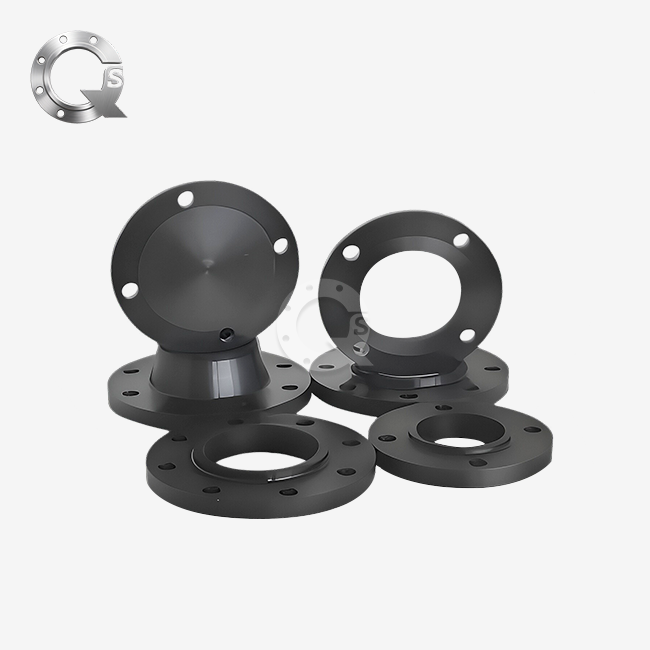
Heat treatment plays a pivotal role in the production of A105 components. While forgings can sometimes be supplied in the "as-forged" condition if the cooling rate from the forging temperature is controlled, normalization is the standard requirement for ASTM A105.
Normalization involves heating the forged flange to approximately 900°C to 950°C and holding it at that temperature for a specific duration based on thickness, followed by cooling in still air. This process achieves several goals:
1. Grain Refinement: It breaks down coarse grain structures formed during forging.
2. Stress Relief: It eliminates residual stresses induced by uneven cooling or mechanical working.
3. Uniformity: It ensures consistent mechanical properties throughout the cross-section of the flange.
For thicker sections or specific applications requiring enhanced impact properties, a Quench and Temper (Q&T) process might be utilized, though standard A105 is typically normalized.
Weldability and Carbon Equivalent
One of the most critical aspects of A105 Forged Steel Flanges is their weldability. In piping construction, the flange must be welded to the pipe, and the integrity of this weld is paramount. The weldability of carbon steel is determined by its Carbon Equivalent (CE).
The CE formula predicts the hardenability of the steel during welding. A lower CE indicates better weldability and a lower risk of cold cracking in the Heat Affected Zone (HAZ). ASTM A105 has a relatively low carbon content, resulting in a favorable CE value. However, for thicker flanges or rigorous service conditions, the standard may impose a stricter CE limit (often 0.50% max).
When welding A105 flanges, pre-heating may be required depending on the thickness of the material and the ambient temperature to prevent rapid cooling, which can lead to brittle microstructures. Post-weld heat treatment (PWHT) is generally not required for A105 unless specified by the design code for specific corrosive environments or thickness constraints.
Temperature Limits and Pressure Ratings
While A105 is excellent for ambient and elevated temperatures, it has limitations.
· High Temperature: A105 is generally suitable for service up to roughly 425°C (800°F). Above this temperature, the carbides in the steel can convert to graphite (graphitization), which significantly weakens the material. For temperatures exceeding this limit, alloy steels like ASTM A182 F11 or F22 are recommended.
· Low Temperature: Standard A105 is not suitable for low-temperature (cryogenic) service because it undergoes a ductile-to-brittle transition. At temperatures below -29°C (-20°F), the impact energy drops sharply. For such applications, materials like ASTM A350 LF2, which are impact-tested at low temperatures, should be used instead.
The pressure rating of the flange is determined by combining the material class with the temperature, referencing ASME B16.5 tables. As temperature rises, the allowable working pressure of an A105 flange decreases.
Quality Control and Testing
To ensure compliance with ASTM A105, rigorous testing is conducted.
· Chemical Analysis: Every heat of steel is analyzed to verify it meets the composition limits.
· Tensile Testing: Samples are pulled to verify yield strength, tensile strength, and elongation.
· Hardness Testing: Brinell or Rockwell hardness tests ensure the material is not too hard for machining or welding.
· Non-Destructive Testing (NDT): Depending on the application and supplementary requirements (S1 to S5 in the specification), flanges may undergo Ultrasonic Testing (UT) to detect internal flaws, or Magnetic Particle Testing (MT) to find surface cracks.
Contact QinSteel for Expert A105 Forged Steel Flanges Solutions
Navigating the technical specifications of piping components requires a partner who understands the nuances of metallurgy and manufacturing standards. At QinSteel, we specialize in supplying high-quality A105 Forged Steel Flanges that meet the most stringent international requirements. Whether you require standard ASME B16.5 flanges or custom-forged solutions for complex geometries, our team is equipped to deliver precision and reliability.
We invite you to contact us to discuss your project requirements. Our engineering team can assist with material selection, pressure-temperature rating calculations, and logistical planning to ensure your project stays on schedule.
Email: info@sxqinsteel.com
FAQs
Q: What is the main difference between ASTM A105 and A106?
A: ASTM A105 covers forged carbon steel piping components (fittings, flanges), while ASTM A106 covers seamless carbon steel pipe. While they are often compatible and used together, they refer to different product forms and manufacturing processes.
Q: Can A105 flanges be used in sour service (H2S environments)?
A: Standard A105 may not be suitable for sour service without specific controls. NACE MR0175/ISO 15156 imposes limits on hardness (typically max 22 HRC) and chemistry to prevent Sulfide Stress Cracking (SSC). If sour service is required, this must be specified, and the material may need specific heat treatment or chemistry adjustments.
Q: Is A105 suitable for galvanized coatings?
A: Yes, A105 is frequently galvanized. However, care must be taken during the pickling and galvanizing process to avoid hydrogen embrittlement, especially for high-strength fasteners often used with these flanges.
Q: What is the maximum temperature for A105 flanges?
A: The generally accepted maximum temperature for A105 is 425°C (800°F). Beyond this, there is a risk of graphitization, which compromises the steel's strength.
Q: Are A105 flanges impact tested?
A: Standard A105 specifications do not require impact testing (Charpy V-Notch) unless Supplementary Requirement S5 is invoked. If the service temperature is low (but above -29°C) or critical, impact testing should be specified to ensure toughness.
References
1. ASTM A105/A105M - Standard Specification for Carbon Steel Forgings for Piping Applications.
2. ASME B16.5 - Pipe Flanges and Flanged Fittings.
3. ASME B31.3 - Process Piping Code.
4. NACE MR0175 / ISO 15156 - Petroleum and natural gas industries — Materials for use in H2S-containing environments in oil and gas production.
Learn about our latest products and discounts through SMS or email