- English
- French
- German
- Portuguese
- Spanish
- Russian
- Japanese
- Korean
- Arabic
- Greek
- German
- Turkish
- Italian
- Danish
- Romanian
- Indonesian
- Czech
- Afrikaans
- Swedish
- Polish
- Basque
- Catalan
- Esperanto
- Hindi
- Lao
- Albanian
- Amharic
- Armenian
- Azerbaijani
- Belarusian
- Bengali
- Bosnian
- Bulgarian
- Cebuano
- Chichewa
- Corsican
- Croatian
- Dutch
- Estonian
- Filipino
- Finnish
- Frisian
- Galician
- Georgian
- Gujarati
- Haitian
- Hausa
- Hawaiian
- Hebrew
- Hmong
- Hungarian
- Icelandic
- Igbo
- Javanese
- Kannada
- Kazakh
- Khmer
- Kurdish
- Kyrgyz
- Latin
- Latvian
- Lithuanian
- Luxembou..
- Macedonian
- Malagasy
- Malay
- Malayalam
- Maltese
- Maori
- Marathi
- Mongolian
- Burmese
- Nepali
- Norwegian
- Pashto
- Persian
- Punjabi
- Serbian
- Sesotho
- Sinhala
- Slovak
- Slovenian
- Somali
- Samoan
- Scots Gaelic
- Shona
- Sindhi
- Sundanese
- Swahili
- Tajik
- Tamil
- Telugu
- Thai
- Ukrainian
- Urdu
- Uzbek
- Vietnamese
- Welsh
- Xhosa
- Yiddish
- Yoruba
- Zulu
Does ASTM A194 2H Heavy Hex Nut Only Fit Stud Bolts and Fully Threaded Studs? Can It Match Standard Hex Bolts?
Aug 24 2026
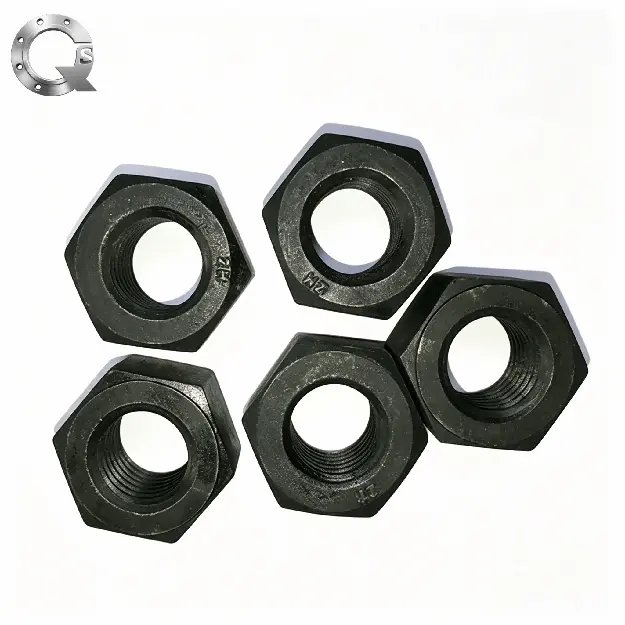
ASTM A194 2H Heavy Hex Nut is a high-strength carbon steel fastener engineered for high-pressure and high-temperature industrial piping, pressure vessel, and flange connection systems. A common technical confusion among mechanical engineers, procurement specialists, and construction technicians is its pairing applicability, specifically whether this premium heavy hex fastener is limited exclusively to double-ended studs and full-threaded studs, or supports flexible matching with conventional hex bolts for diverse industrial assembly scenarios. This article comprehensively clarifies its compatibility standards, structural advantages, application limitations, and industry specification requirements to help enterprises select fastener matching schemes accurately and avoid specification mismatches that affect project safety and stability.
Core Structural and Standard Attributes of Heavy Hex Nuts
To resolve the matching confusion of industrial fasteners fundamentally, it is essential to start with the manufacturing specifications and structural design characteristics of heavy hex fasteners. Governed by the ASTM A194/A194M-20a standard, this type of high-load nut is specially optimized for heavy-duty industrial connection scenarios, differing significantly from ordinary commercial hex nuts in wall thickness, bearing area, thread precision, and mechanical performance. The heavy-duty structural design expands the stress-bearing range of the nut end face, effectively dispersing high torque and high pressure generated in flange connections, thus preventing loosening, thread deformation, and joint leakage in extreme working environments.
Most practitioners traditionally believe that these industrial nuts are only suitable for matching studs, which stems from the mainstream supporting scheme of pressure vessel industry standards. In conventional petrochemical and thermal power projects, pressure flange connections mostly adopt the combination of full-thread studs and heavy hex nuts, forming a stable high-strength connection system. However, industry standards do not impose mandatory restrictions on bolt types, which creates a flexible space for the matching application of standard hex bolts.
Compatibility Verification: Studs vs. Standard Hex Bolts

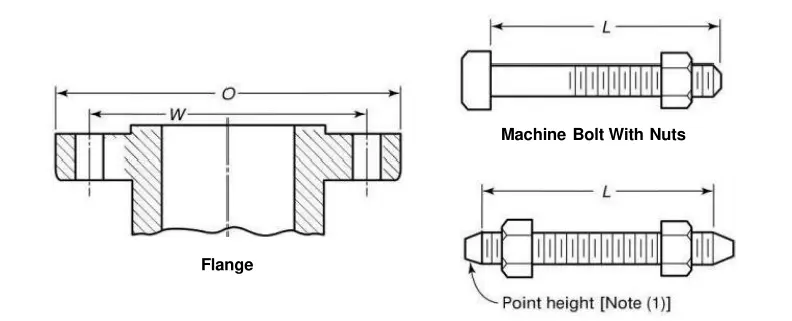
Standard double-ended studs and fully threaded studs are the most ideal matching accessories for this grade of high-pressure heavy hex nut, which is widely recognized and adopted in global industrial engineering. Studs feature full-section uniform threads, no bolt head interference, and symmetrical stress distribution on both ends, which perfectly fits the heavy-load bearing characteristics of the heavy hex nut. When used in pairs on both sides of flanges, this matching combination can maintain consistent clamping force under long-term high temperature and high pressure, ensuring the tightness and structural stability of pipeline connections, and is the preferred scheme for key industrial equipment connections such as high-pressure valves, heat exchangers, and chemical reaction kettles.
In terms of standard hex bolt matching, technically qualified high-strength hex bolts can also be perfectly assembled with the heavy hex nut without thread mismatch or structural conflict. As long as the hex bolt meets the matching thread specification (inch or metric thread consistency) and reaches the corresponding strength grade (such as ASTM A193 B7 grade), the assembly can achieve stable connection effects. Many on-site construction teams choose this matching method for non-critical high-pressure connection positions, which can effectively reduce procurement costs and simplify construction procedures while meeting equipment operation standards.
It is worth noting that although standard hex bolts are compatible, there are subtle differences in service life and stress resistance compared with stud matching schemes. Heavy hex fasteners exert larger contact pressure on the connecting surface, and ordinary hex bolts with insufficient hardness may produce local stress concentration at the bolt head connection, affecting long-term fatigue resistance. Therefore, engineers need to select matching schemes according to actual working pressure, temperature, and equipment importance.
Key Application Scenarios and Matching Recommendations
The flexible matching performance of high-strength industrial nuts makes it adaptable to a variety of complex industrial scenarios. In core high-pressure and high-temperature working conditions such as petrochemical pipelines, boiler pressure vessels, and marine engineering equipment, it is still recommended to prioritize full-thread studs to give full play to the extreme load-bearing advantages of this high-spec industrial nut. This standard matching scheme has been verified by countless industrial projects and fully complies with international industrial safety specifications, effectively avoiding equipment failure risks caused by fastener matching errors.
For medium and low-pressure auxiliary equipment, pipeline supports, and general mechanical assembly scenarios, qualified standard high-strength hex bolts can be used for matching. This diversified matching mode not only ensures the basic connection strength and stability but also improves the flexibility of material procurement and on-site construction, which is more in line with the cost-control needs of industrial projects. In addition, the surface treatments of the nut, including black oxide, hot-dip galvanizing, and PTFE coating, can further enhance corrosion resistance, adapting to humid, corrosive, and outdoor open-air working environments.
FAQs
Q1: Is thread consistency the only condition for matching heavy hex nuts with hex bolts?
A1: No. Thread specification consistency is the basic assembly condition, but bolt strength grade and material performance are also key factors. It is necessary to ensure that the strength grade of the matched hex bolt matches the load level of the heavy hex nut to avoid uneven stress and local damage of fasteners caused by performance mismatch.
Q2: What are the risks of mismatching ordinary low-strength hex bolts with heavy hex nuts?
A2: Ordinary low-strength hex bolts cannot bear the high torque and clamping force of heavy hex fasteners, which is prone to thread sliding, bolt bending, and connection loosening. In high-pressure environments, it may even cause pipeline leakage and equipment failure, bringing major safety hazards to industrial production.
Q3: Can coated heavy hex nuts be matched with standard hex bolts?
A3: Yes. Surface-coated heavy-duty fasteners retain complete thread precision and structural dimensions, and can be normally matched with qualified standard hex bolts and studs. The coating only improves corrosion resistance and does not affect assembly compatibility and connection strength.
Q4: What specifications need to be confirmed in advance for on-site matching construction?
A4: Before construction, it is necessary to confirm thread size, pitch, bolt strength grade, nut surface treatment mode, and working condition parameters (temperature, pressure, medium environment) to ensure that the matching scheme meets ASTM industrial standards and project design requirements.
Contact QinSteel for Premium ASTM A194 2H Heavy Hex Nut Customization and Matching Solutions
As a professional industrial fastener manufacturer and supplier focusing on high-standard pipeline and pressure vessel supporting parts, QinSteel has rich production experience and on-site engineering service capabilities in the field of high-strength heavy hex fasteners. We strictly follow ASTM international standards to produce all series of these heavy-duty fastening components, with complete specifications, stable mechanical performance, and customizable surface treatments to meet the differentiated matching needs of studs and standard hex bolts in various industrial scenarios.
Our professional technical team can provide one-stop services including fastener matching consultation, specification selection guidance, customized processing, and batch supply according to customers’ project working conditions. Whether it is high-pressure core equipment connection or conventional mechanical assembly supporting, we can provide accurate and reliable fastener solutions. For technical consultation, sample testing, and bulk order cooperation, please contact us via email: info@sxqinsteel.com. We will respond to your demand within 24 hours and provide professional technical support and favorable quotation services.
References
1. ASTM International. ASTM A194/A194M-20a, Standard Specification for Carbon and Alloy Steel Nuts for Bolts for High-Pressure or High-Temperature Service, or Both[S]. West Conshohocken: ASTM International, 2020.
2. ASME B18.2.2, Standard for Square and Hexagonal Nuts (Inch Series)[S]. American Society of Mechanical Engineers, Latest Revised Edition.
3. ASTM A193/A193M-19, Standard Specification for Alloy-Steel and Stainless Steel Bolting for High Temperature or High Pressure Service and Other Special Purpose Applications[S]. ASTM International, 2019.
4. Industrial Fasteners Institute. Fastener Matching Specification Manual for Pressure Vessel and Pipeline Engineering[M]. USA: Industrial Fasteners Institute Press, 2022.
Learn about our latest products and discounts through SMS or email